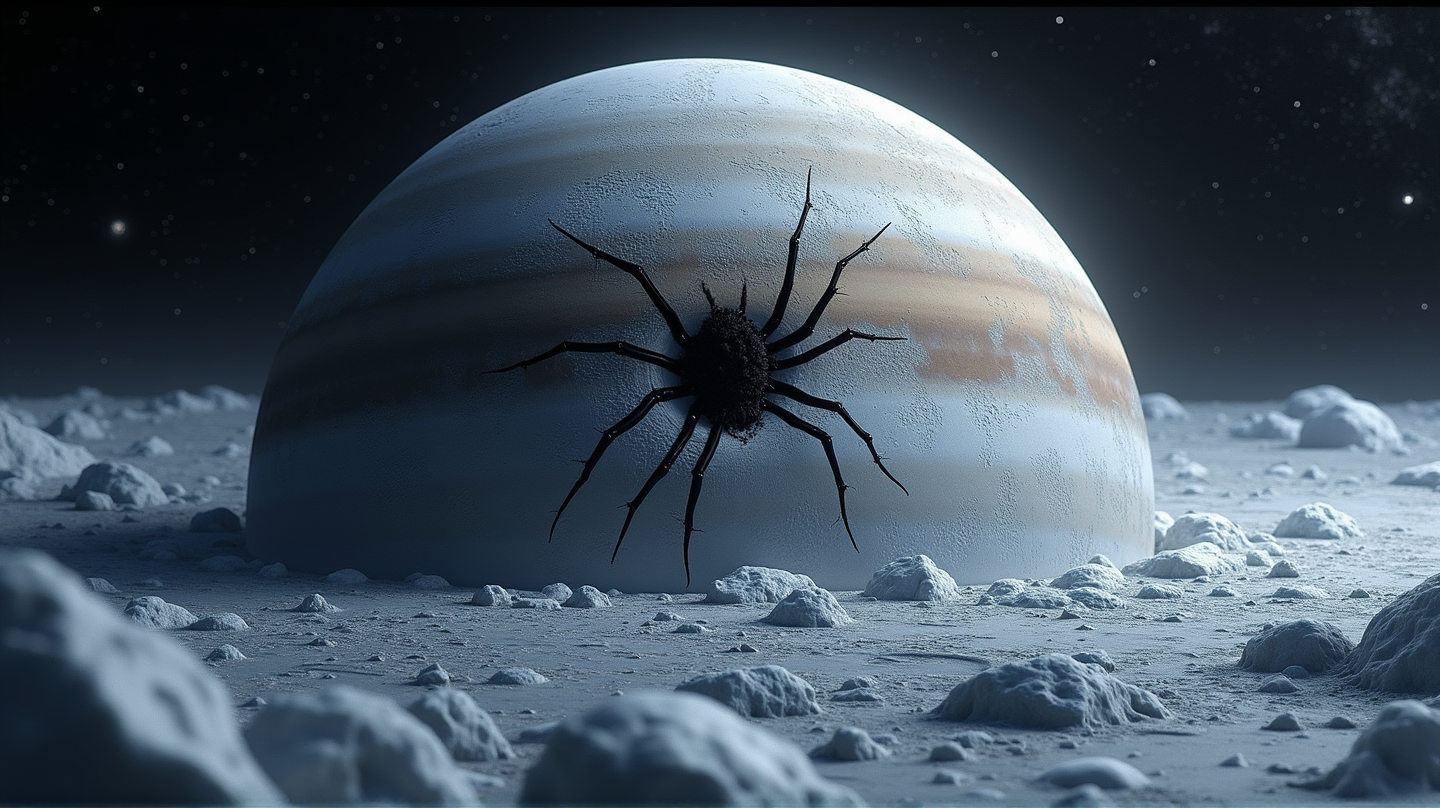
Europa, one of Jupiter’s icy moons, presents a curious feature resembling a spider-shaped scar called Damhán Alla. This phenomenon has intrigued scientists since its discovery by NASA’s Galileo satellite in the late 1990s. But what causes this intricate structure, and what secrets might it hold about the conditions beneath Europa’s icy surface?
A Mysterious Mark on Manannán Crater
Within Europa’s Manannán crater lies a peculiar pattern believed to be the result of briny water once erupting through the moon’s fractured crust. Named “Damhán Alla” — an Irish term translating to “spider” or “wall demon” — the structure presents a striking visual with its branching ridges resembling Earth’s “lake stars.”
The Role of Salty Brine
Research led by scientists at Trinity College Dublin suggests that these features indicate subsurface brine eruptions. Field observations, laboratory experiments, and computer models support the theory that briny water beneath Europa’s ice flows upwards, freezes, and creates intricate formations similar to Earth’s natural phenomena.
Insights into Europa’s Subsurface World
These surface patterns, like Damhán Alla, are not merely artistic expressions of nature. They could point to isolated brine pools beneath the ice, revealing much about the potential for life on Europa. The possibility of subsurface oceans, where life might exist, makes this icy moon particularly exciting for astrobiologists.
The Europa Clipper Mission’s Promise
As captivating as these observations are, higher-resolution images might further unlock Europa’s secrets. NASA’s upcoming Europa Clipper mission, set to arrive in 2030, aims to capture more detailed photos and data, which could vastly enhance our understanding of the moon’s geology and hydrology.
Reflections of Terrestrial Patterns
According to the research team, the formation of lake stars on Earth provides an analogy for similar phenomena on Europa. As on Earth, where radial channels flow from melting snow on frozen lakes, Europa’s features suggest that liquid brine may enact similar processes before they freeze permanently.
A Glimpse into Icy Ocean Worlds
The narrative of Europa’s spider-like scar extends beyond the mysteries of this single moon, potentially offering insights into other icy ocean worlds within our solar system. “Lake stars are fascinating,” says Lauren McKeown, lead author of the study. She emphasizes how such patterns might reveal hidden subsurface activities essential for understanding extraterrestrial environments.
According to Republic World, ongoing exploration and future missions could transform our understanding of life beyond Earth, with Jupiter’s Europa standing at the forefront of this exciting frontier in space exploration.